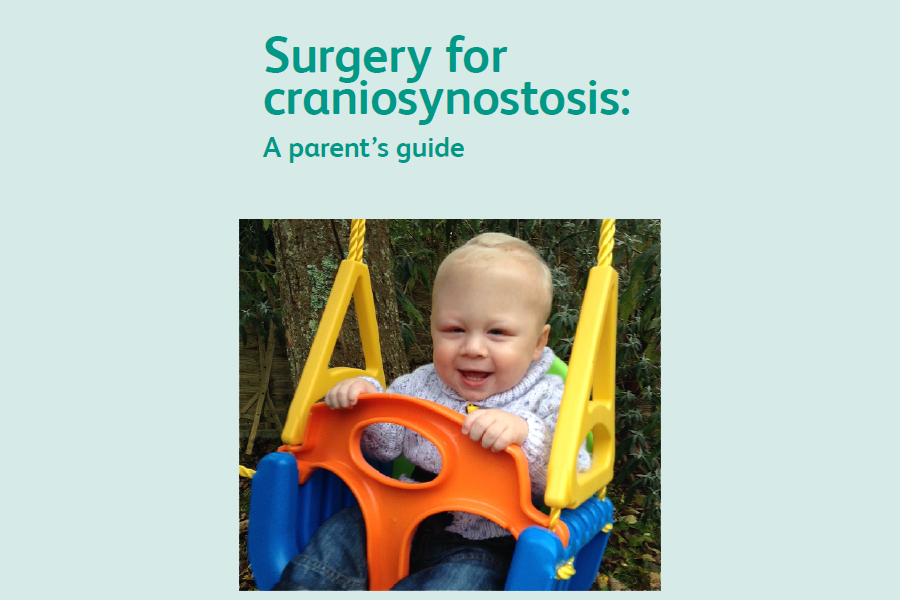
This resource is aimed at parents of children with craniosynostosis who have recently received a diagnosis and/or who are approaching their child’s first surgery.
The early stages of craniosynostosis can feel overwhelming and bring about a mix of emotions and concerns. These booklets support parents to navigate diagnosis and early treatment by providing information, reassurance, stories from other parents and practical advice.
There are two booklets available:
- My baby has craniosynostosis: A parent’s guide to managing a diagnosis
- Surgery for craniosynostosis: A parent’s guide
“This is the information I really needed to read when my son was born. It would have helped me immensely. I wish this booklet had been around then.”
Parent
“The booklets raise important issues which are often difficult to broach in clinic. This research hits the mark on many levels.”
Healthcare Professional
Podcast
You can hear more about this resource in this episode of the Appearance Matters podcast.
The Research
Read More
The booklets were developed in close collaboration with a panel of parents, Headlines Craniofacial Support and specialist NHS psychologists.
The content was informed by an online UK survey of 111 parents of children with craniosynostosis and a series of focus groups. The booklets were evaluated by 96 parents, family members and healthcare professionals before being approved for UK-wide distribution.
The booklets have now been translated into Polish, Romanian, Punjabi Indian and Urdu Pakistani.
Publications
Read More
Costa, B., Edwards, W., Wilkinson-Bell, K., & Stock, N.M. (2023). Raising a child with craniosynostosis: Psychosocial adjustment in caregivers. The Cleft Palate Craniofacial Journal, 60(10):1284-1297. https://doi.org/10.1177/10556656221102043.
Stock, N.M., Kearney, A., Horton, J., Pearse, L., O’Driscoll, M., Murfett, L., Hilton, C., Pearse, K., & Wilkinson-Bell, K. (2022). A booklet to promote psychological health in new families affected by craniosynostosis. Journal of Craniofacial Surgery, 33(6):1670-1673. doi: https://doi.org/10.1097/SCS.0000000000008454.
Stock, N.M., Pearse, L., Murfett, L., Pearse, K., Kearney, A., Horton, J., Hilton, C., & Wilkinson-Bell, K. (2025). Surgery for craniosynostosis: Developing a psychosocial booklet for families. Journal of Craniofacial Surgery, 36(1):26-29. https://doi.org/10.1097/SCS.0000000000010422.
The Team
Read More
Nicola Stock
Acknowledgements
Read More
This work was funded by the University of the West of England, Bristol and the VTCT Foundation Small Grant scheme. We are grateful to our main collaborator Headlines Craniofacial Support, our parent panel, the NHS specialist craniofacial teams and the families who helped us to evaluate the booklets. The project involved Alder Hey Children’s NHS Foundation Trust, Birmingham Women’s and Children’s NHS Foundation Trust, Oxford University Hospitals NHS Foundation Trust and Great Ormond Street Hospital for Children NHS Foundation Trust.